PKI provides assurance of public key. It provides the identification of public keys and their distribution. An anatomy of PKI comprises of the following components.
- Public Key Certificate, commonly referred to as ‘digital certificate’.
- Private Key tokens.
- Certification Authority.
- Registration Authority.
- Certificate Management System.
Digital Certificate
For analogy, a certificate can be considered as the ID card issued to the person. People use ID cards such as a driver’s license, passport to prove their identity. A digital certificate does the same basic thing in the electronic world, but with one difference.
Digital Certificates are not only issued to people but they can be issued to computers, software packages or anything else that need to prove the identity in the electronic world.
- Digital certificates are based on the ITU standard X.509 which defines a standard certificate format for public key certificates and certification validation. Hence digital certificates are sometimes also referred to as X.509 certificates.Public key pertaining to the user client is stored in digital certificates by The Certification Authority (CA) along with other relevant information such as client information, expiration date, usage, issuer etc.
- CA digitally signs this entire information and includes digital signature in the certificate.
- Anyone who needs the assurance about the public key and associated information of client, he carries out the signature validation process using CA’s public key. Successful validation assures that the public key given in the certificate belongs to the person whose details are given in the certificate.
The process of obtaining Digital Certificate by a person/entity is depicted in the following illustration.
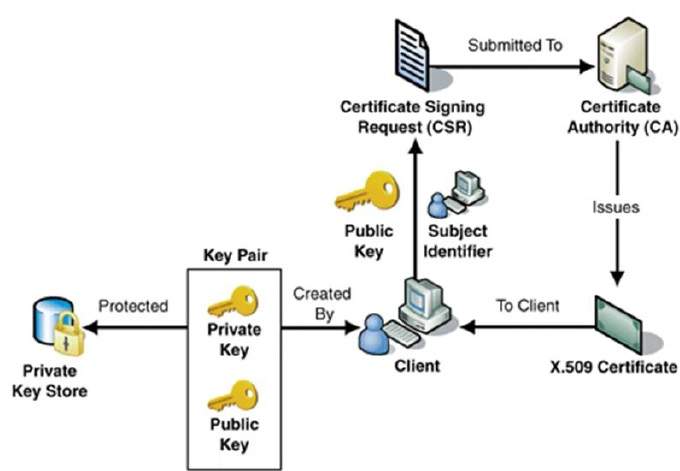
As shown in the illustration, the CA accepts the application from a client to certify his public key. The CA, after duly verifying identity of client, issues a digital certificate to that client.
Leave a Reply