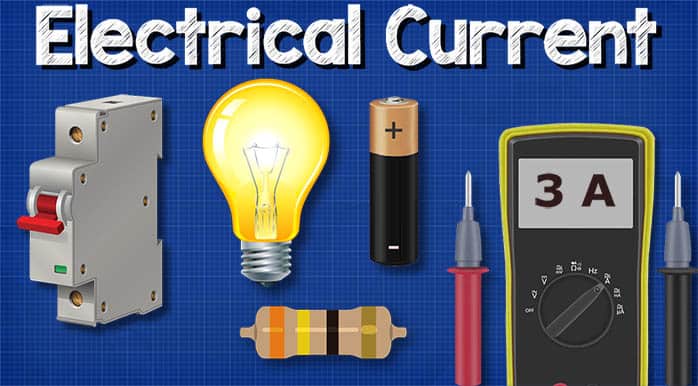
Learn about electrical current to understand the different types, the symbols used to represent them, how to measure current and how safety devices are used to protect us and our electrical circuits.
What is Current?
Current is the flow of electrons in a circuit. To use electricity, we need electrons to flow in the same direction around a circuit, we usually use copper cables to form the circuit because copper is a very good electrical conductor, which means the atoms that make copper have a loosely bound electron in that outermost or valence shell, which is free to move around inside the metal.
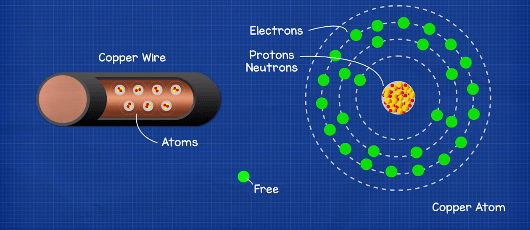
This free electron is very easy to move, which is why copper is so popular. It’s so easy to move that it will naturally move to other copper atoms by itself. But this occurs randomly in any and all directions, which is of no use to us. We wrap copper wires in rubber because the rubber is an insulator, which means it does not allow free electrons to pass through it. That provides a barrier and keeps the electricity within the wires and away from us.
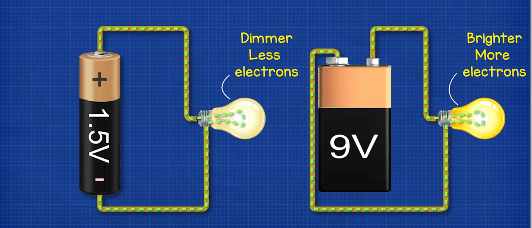
For us to use electricity to power our devices- we need lots of electrons to flow in the same direction along a circuit. We can then place things like lamps in the way of these electrons so that they have to flow through it and generate light and heat in the process. To do this, we need to force the electrons to move and we can do that by applying a voltage. Voltage is the pushing force, it’s like pressure in a water pipe. The more pressure we have, the more water can flow, the more voltage we have, the more electrons can flow.
We can measure pressure without there being any water flowing and we can measure voltage without there being any current flowing. But we can’t measure how much water is flowing if no water is flowing. And we can’t measure the electrical current if no electrons are flowing, if we take a copper wire. There is no voltage difference between the two ends so the free electrons move around randomly. This random movement is not considered a current. But if we take a battery of, say, one point five volts and connect the wire across the two terminals, then there is now a difference of one point five volts across the wire.
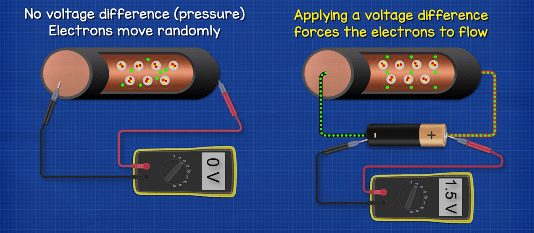
And this difference is going to force the electrons to flow in the same direction. We’ve covered the basics of voltage in detail in our previous article. So we need a lot of electrons to flow along a circuit and through our lamps to get them to shine brightly, however, the cables and lamp can only handle a certain amount of electrons passing through them, just like a pipe is rated to handle a certain amount of water passing through it or a certain pressure.
If it were to exceed this, then the pipe will just burst. Likewise, if too many electrons pass through the cable or the lamp, then they will burst or burn out. We refer to the flow of electrons as current, and we measure this in a unit of amperes, although you usually just hear people say amps. This is also represented with a capital A..
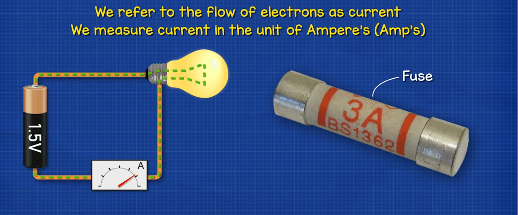
For example, this fuse has a three and a capital A. which means it’s rated for three amps of current. We’ll look at how fuses work a little later in this article.
Leave a Reply