
Learn about the full wave bridge rectifier, the half wave rectifier the full wave rectifier, center tapped transformers, diodes, load, oscilloscope, waveform, DC, AC, voltage current, capacitors, bleeder resistor to learn how full wave bridge rectifiers work.

This is a full wave bridge rectifier. It’s used to power our electronic circuits, so we’re going to learn in detail how they work in this article.
Electricity is dangerous and can be fatal, you must be qualified and competent to carry out any electrical work.
What is a Full Bridge Rectifier
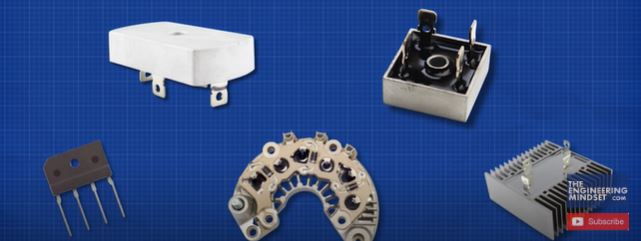
Full bridge rectifiers look like this, there are many shapes and sizes but they essentially consist of 4 diodes in a certain arrangement. They are usually aligned in a Dimond configuration, but they can also be aligned in other ways such as these.
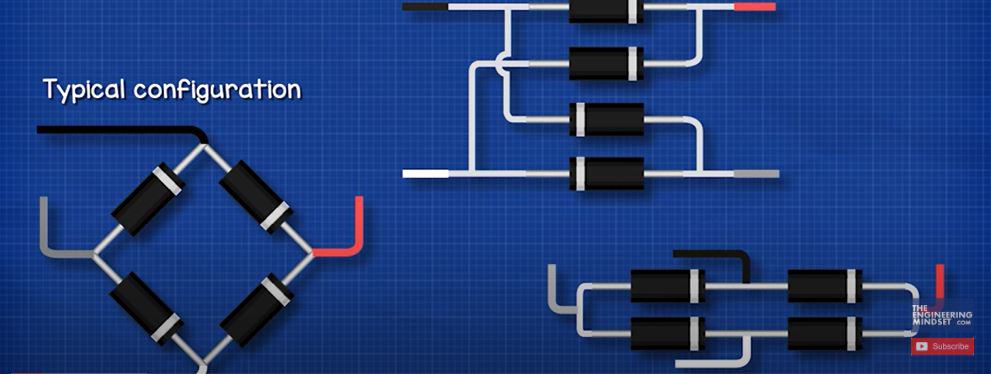
We typically find them represented on engineering drawings like this.
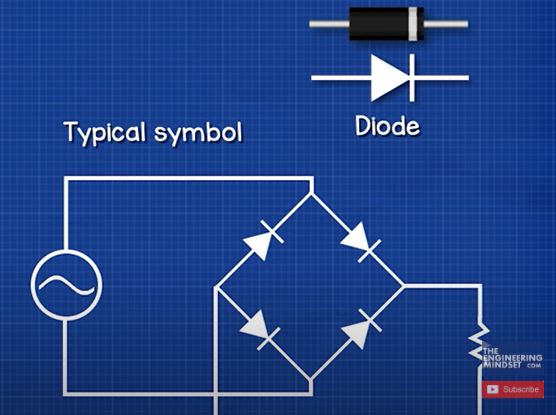
This being the symbol for a diode. The arrow points in the direction of conventional current. This is showing that AC electricity is the input and DC electricity is the output.
The full bridge rectifier converts AC alternating current, into DC direct current. Why is that important? Because the power outlets in our homes provide AC but our electronic devices use DC, so we need to convert the AC into DC electricity.
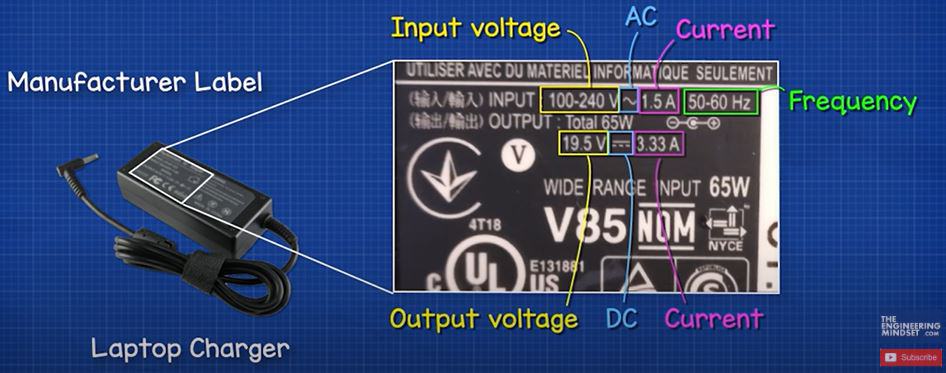
For example, a laptop charger takes AC from the power outlet and convers this to DC to power the laptop. If you look at the power adapter for your laptop and electronic devices, the manufacturers label tells you it’s converting AC to DC. In this example it states it needs an input of between 100 and 240V, with the symbol for AC electricity, and it will draw 1.5Amps of current. It will then output 19.5V of DC electricity and 3.33 Amps of current. Notice it also states 50-60 Hz, this is the AC frequency and we’ll look at that in just a moment.
In AC electricity the voltage and current constantly change direction between forwards and backwards. That’s because there’s a magnetic field in the AC generator which essentially pushes and pulls the electrons in the wires. This is therefore changing between positive and negative values as it flows forwards and backwards, the voltage is not constant, even though the multimeter makes it look like it is. If we plotted this, we get a sine wave pattern. The voltage changes between a peak positive and peak negative value as the maximum intensity of the magnetic field passes the coils of wire.
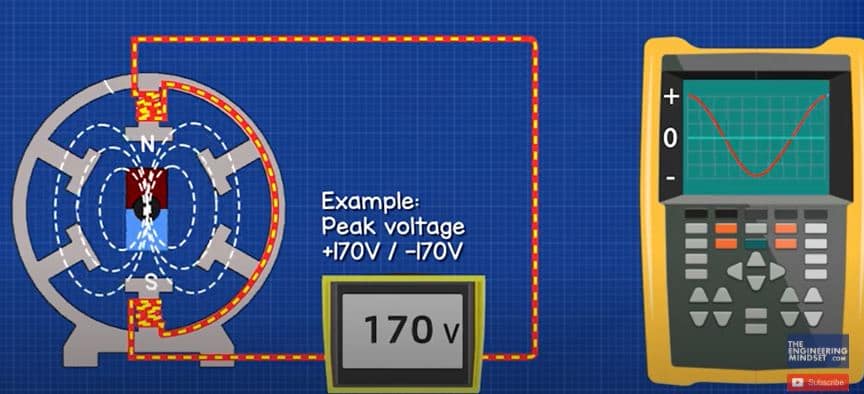
This example reaches 170V at its peaks, so if we plotted these values we have positive and negative peaks of 170V. If we took the average of these values we get zero volts. That’s not very useful, so a clever engineer decided to use the root mean squared voltage. That is what our multimeters calculate when we connect them to the electrical outlets.
To find the peak voltage, we multiply the RMS voltage by the square root of 2 which is roughly 1.41.
To find the RMS voltage we divide the peak voltage by 0.707.
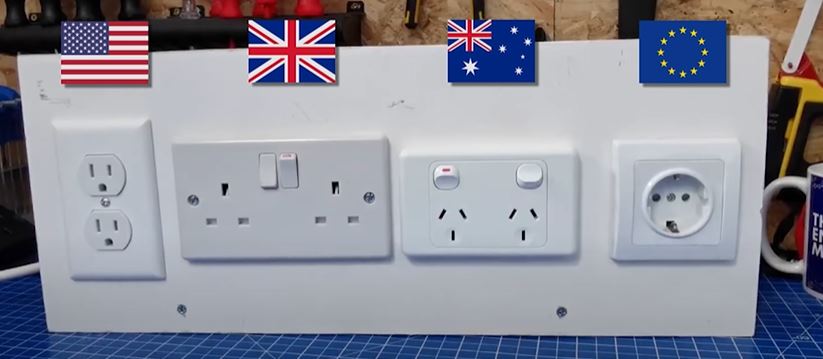
For example here I have a North American, British, Australian and European power outlet. This multimeter shows basic wave forms and when I connect to any of these between the phase and neutral, we see a sine wave, indicting it is AC electricity. Notice that the British and European outlets are 230V, the Australian is 240V but all three are at a frequency of 50 Hz, however the north American outlet reads 120V at a frequency of 60Hz.
The frequency is measured in Hertz but this just means the sine wave is repeating 60 times per second in the north American electrical systems and 50 times per second in the rest of the world. The voltage is lower in the north American system at 120V where as it’s 230-240V in the rest of the world. The peak voltage of each electrical system is therefore as follows.
In DC electricity the voltage is constant and in the positive region, the electrons do not reverse they all flow in just one direction. So, if I measure this battery, we see a flat line in the positive region at around 1.5V so this is DC electricity.
This solar panel also produces DC, we can see it produces a flat line at around 4V on the multimeter. We can use this adapter to measure a USB port, we can see it’s providing around 5V and if we plot this with the other multimeter, we again see a constant flat line indicating it is DC electricity.
This is a full wave bridge rectifier. On these input terminals we see around 12V AC with a sine wave. And on these output terminals we see around 14V of DC. So this device is converting AC to DC. The voltage is slightly higher because of the capacitor, and we’ll see why that is later in this video.
This only converts AC to DC, it will not convert DC to AC. For that we need an inverter, which uses special electronic components to achieve that but we won’t cover that in this article.
How It Works
The rectifier consists of diodes. A diode is a semiconductor device which allows current to flow through it, but, in only one direction. So, if we connect this lamp to a DC power supply, it will illuminate. We can reverse the leads and it will still illuminate. If I place a diode on the red wire, and connect this to the positive, it will again illuminate. But now, when I reverse the leads, the diode blocks the current and the lamp remains off. So, it only allows current to flow in one direction and we can use this to control the direction of current in a circuit to form DC electricity.
Leave a Reply