We need to understand some fundamentals of how electricity works before we can understand the battery.
Firstly, electricity is the flow of electrons in a circuit. Batteries can provide the pushing force that moves the electrons through the circuit. The electrons want to get back to their source, and they will immediately take any path that’s possible to achieve that. By placing things such as lamps in the way of the electrons we can force them to do work for us such as illuminate the lamp.
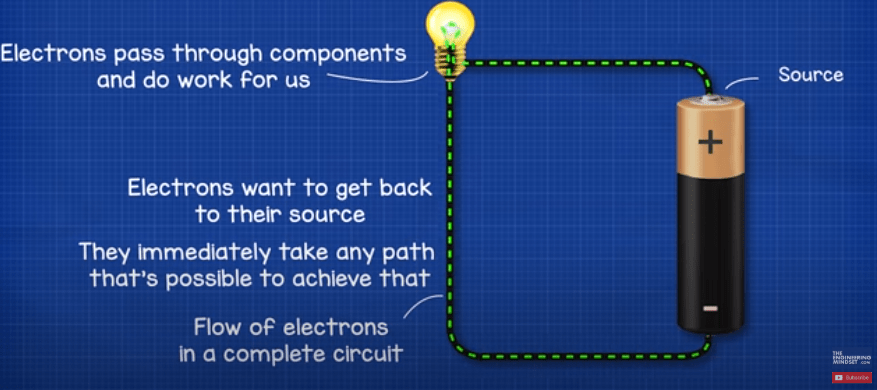
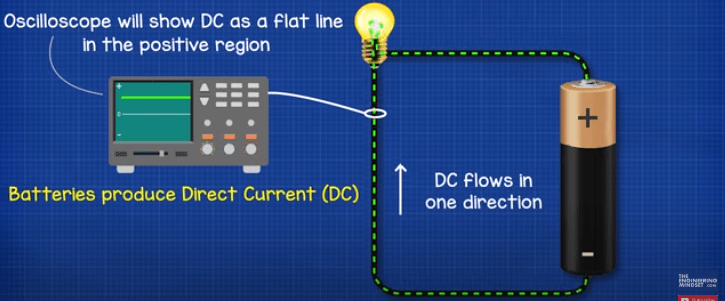
Batteries produce DC electricity or Direct current. This means the electrons flow in just one direction from the negative to the positive. An oscilloscope will show DC as a flat line in the positive region. You can think of DC electricity like a river which flows in just one direction.
In these animations we show electron flow, which is from negative to positive but you might be used to seeing conventional current which is from positive to negative. Electron flow is what’s actually occurring but conventional current was the original theory which is still widely used and taught to this day. Just be aware of the two and which one we’re using.
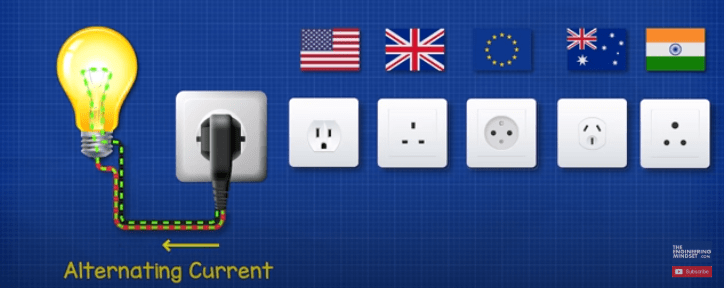
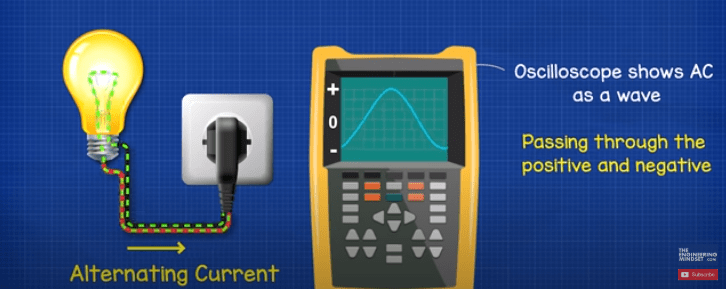
The electricity you get from the power outlets in your homes provides AC electricity or alternating current, this is different than the electricity provided by a battery. With Alternating Current the electrons flow forwards and backwards continuously much like the tide of the sea which flows in and out between high tide and low tide. An oscilloscope will show AC as a wave running through both the positive and negative regions because it’s flowing forwards, that’s positive, and backwards, that’s negative.
If we look at a section of copper wire, inside this we find copper atoms. At the centre of an atom we have protons and neutrons, the protons are positively charged and the neutrons are considered neutral so they have no charge. Orbiting these are electrons, electrons are negatively charged.
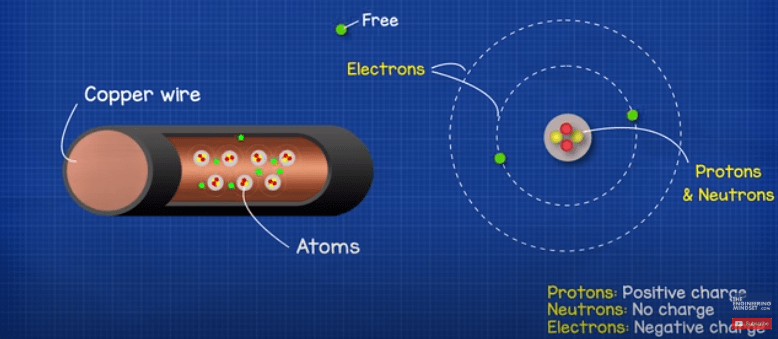
Some of these electrons are free to move to other atoms. They will naturally move between other atoms but in random directions, which is of no use to us. We need lots of electrons to flow in the same direction and we can do that by providing a voltage difference from a power source such as a battery.
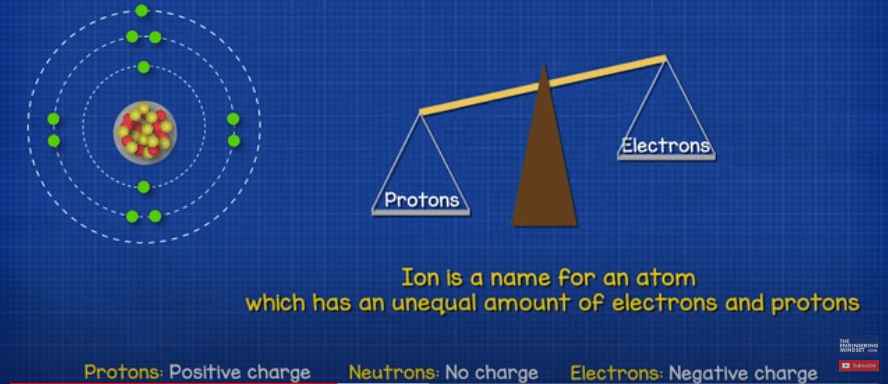
When we talk about atoms, you will often hear the term Ion used. An Ion is just an Atom which has an unequal amount of electrons or protons. An atom has a neutral charge when a it has the same number of protons and electrons, because the protons are positively charged and the electrons are negatively charged, so they balance out. If the atom has more electrons than protons then then it’s a negative ion. If the atom has more protons than electrons, it’s a positive ion.
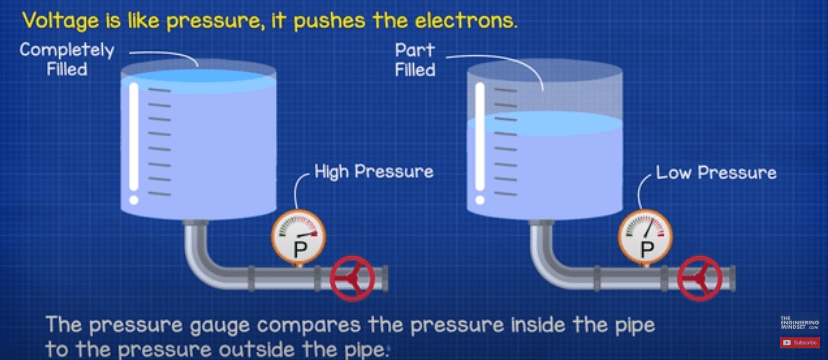
Voltage is like pressure in a water tank. To know how much pressure we have, we must compare the pressure inside the pipe to the pressure outside, and we use a pressure gauge to do that. When it comes to voltage, we use a voltmeter to measure the difference in voltage between two different points. If we measure the difference across the battery, we get 1.5V, but if we measure the same end then we get 0V because it’s the same end so there’s no difference.
Some materials allow electrons to pass through easily, these are known as conductors. Copper and most metals are examples of this. Other materials do not allow electrons to pass through, these are known as insulators. Rubber and most plastics are examples of this. That’s why we use copper wires with rubber insulation. The copper transports the electricity to where we need it and the rubber keeps us safe.
By mixing certain materials together we can cause chemical reactions. This is when the atoms of one material interact with the atoms of another material and during this interaction atoms will bond together or break apart, electrons can also be captured or released by atoms during the chemical reaction.
OK, now that we have the basics covered, lets look inside a battery and see how it works.
How Does the Alkaline Battery work?
Remember we talked briefly about atoms. Well all these materials inside the battery are made from lots of different atoms tightly packed together. These are represented by the coloured balls, each colour representing a different material and therefore a different atom, for our very simplified example. When we combine all these materials together inside the capsule, we’re going to get a small chemical reaction where the atoms start to interact with each other.
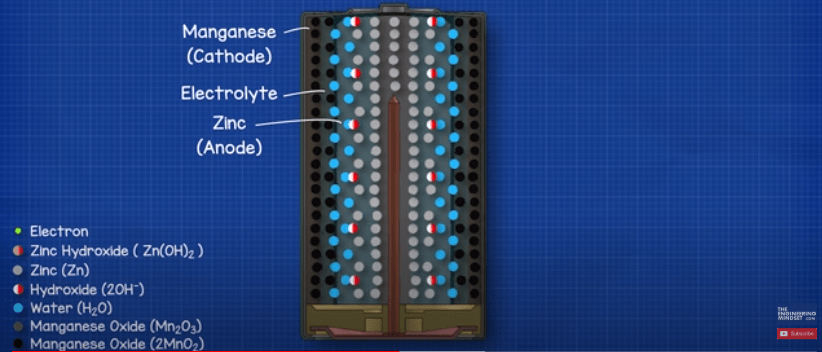
First of all, a hydroxide ion atom within the electrolyte is going to join with a zinc atom in the anode section. This chemical reaction is known as oxidation and will create Zinc Hydroxide, as the zinc and hydroxide combine it will release electrons. These electrons are now free to move and they will collect on the brass pin.
At the same time, a manganese oxide atom is going to join with a water molecule from the electrolyte as well as a free electron in a chemical reaction known as reduction. During the chemical reaction the manganese oxide turns into a slightly different version of manganese oxide, this version no longer needs a hydroxide ion atom so it will eject this into the electrolyte. The water atom is replaced by one ejected from the oxidation reaction. The hydroxide ion is now free and able to pass through the separator. But for now it won’t because there is no room for it in the anode section.
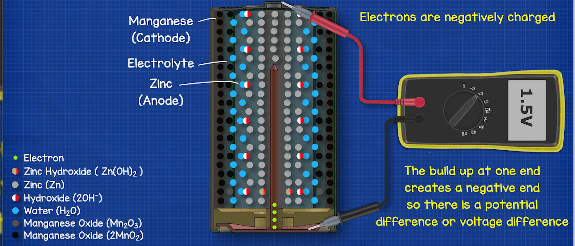
So as you can see we have a build up of electrons at the negative terminal. As electrons are negatively charged, and we now have more electrons at the negative terminal compared to the positive, this means we have a voltage difference between the two ends and we can measure that difference with a multimeter.
Remember we can only measure the difference in voltage between two different points. If we measure the same point we would get zero volts because there is no difference.
Electrons repel each other and want to move to a region with less electrons. The positive region has less electrons, so they will try to reach this terminal. The separator prevents them from flowing inside the battery to reach the positive terminal.
Therefore, the electrons need another route. If we provide the electrons with an external path, such a wire, the electrons will flow through it to get to the positive terminal. By placing things such as a lamp in the way of the electrons, the electrons will have to pass through this and so we get them to do work for us, such as illuminating a lamp.
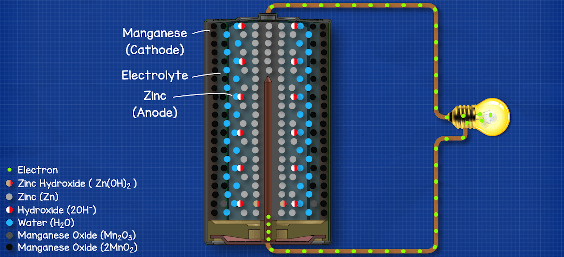
As long as we have a complete circuit between the terminals, the chemical reaction will keep occurring, and electrons flow from the negative terminal. If we remove the wire or break the circuit then the chemical reaction stops.
So let’s recap on the chemical reaction that’s occurring. The free electrons are entering the battery through the positive terminal. This combines with the manganese oxide and a water molecule at the cathode which releases a hydroxide ion into the electrolyte.
The hydroxide ion passes through the separator and joins with a zinc atom to create zinc hydroxide and as this happens electrons and a water molecule are released. The electrons want to get to a region with less electrons, the positive terminal has less electrons so they will flow through the wire to reach this and so the chemical reaction repeats again and again continuously.
However, there’s only a certain amount of material inside the battery so over time it’s going to become harder and harder for the chemical reaction to continue and eventually no more electrons will flow. The battery will now be of no further use and needs to be disposed of.
Leave a Reply