We can use a battery to power some components, but usually a single battery isn’t enough to power our devices, for that we need to combine batteries.
We can connect batteries in two ways. Series or parallel. We have covered these circuit types in great detail previously, check out Series HERE and Parallel HERE.
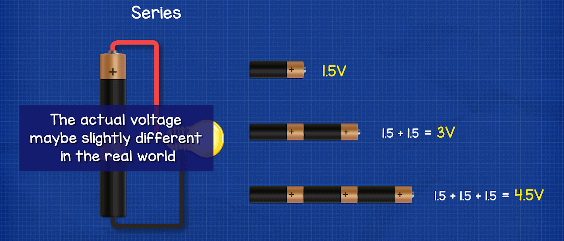
When we connect the batteries in series, the voltage of each battery is added together. So two 1.5V batteries gives us 3V, and 3 batteries gives us 4.5V etc. The actual voltage maybe slightly different in the real world. The voltage increases because each battery is boosting the electrons that enter it, so we get a higher voltage.
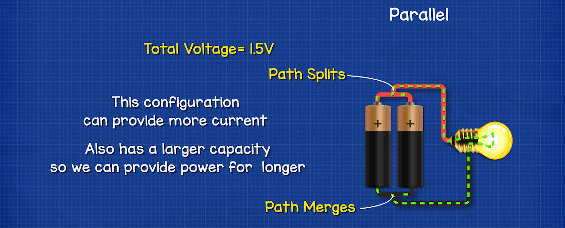
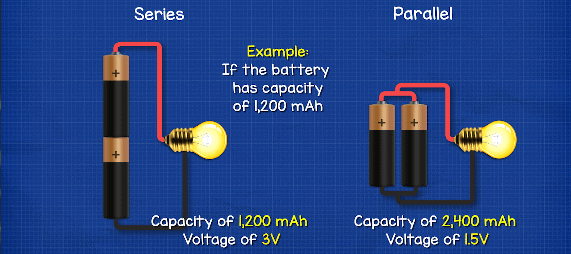
If we connect the batteries in parallel then we will only get 1.5V regardless of how many we connect. That’s because the path merges at the supply but splits at the return, so the electrons will not be boosted. However, this configuration type will be able to provide more current and it will also have a larger capacity so we can power something for longer. For example, If the battery had a capacity of 1,200mAh and we placed two in parallel, we will have a capacity of 2,400 mAh but a voltage of 1.5V. If we wired them in series, we have a capacity of 1,200mAh but a voltage of 3V.
Capacity
We use batteries to power our circuits. But how long can a battery power our circuit for? When we look at the packaging or data sheet for a battery we see a value with the letters m.A.h next to it. This is the milli Amp hour rating.
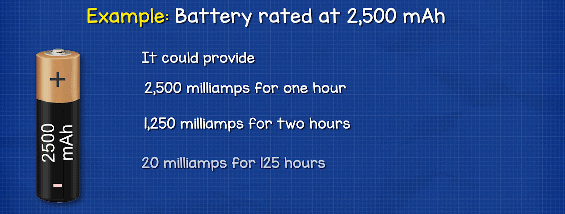
For example, this one has a rating of 2500 mah. That means it could theoretically provide a current of 2500 milliamps for an hour, or 1250ma for 2 hours or 20ma for 125 hours. However, in real life it probably won’t actually last this long because the chemical reaction slows, so the internal resistance of the battery changes as it empties. There are lots of other things that affect this such as age and temperature.
There’s no real way to precisely calculate the life span, the best way is to simply test it. We can however make an estimate of the life span with the following formula:
Battery life = Capacity (mAh) / circuit current (mA).
We have built a free simple calculator on our website where you can estimate the run time of a battery as well as the required capacity. Do check that out HERE.
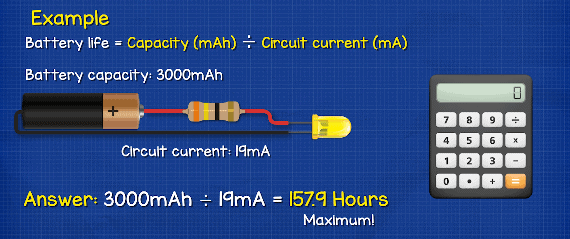
So for example, in this circuit we calculate a demand of 19ma and the battery has a capacity of 3000mAh. So 3000 / 19 gives us 157.9 hours. This is really the best-case scenario though and in reality it almost certainly won’t achieve this.
How to Measure With a Multimeter
To measure the voltage, we simply select the DC function on our multimeter, and then we connect the red lead to the positive terminal and the black lead to the negative. This will give us a voltage reading.

You can see this battery is rated at 1.5V but when we test it we get 1.593V
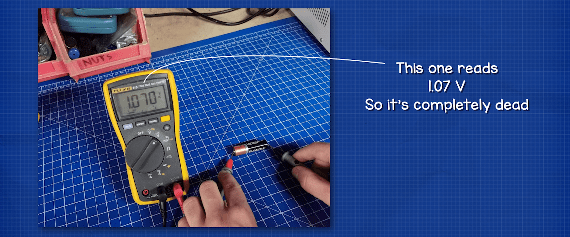
When the battery is dead we get a lower voltage, this one reads 1.07V so it’s completely dead.
However, sometimes we could still get a voltage of around 1.5V even if the battery is dead.
To fully test the battery, we need to test it under a load condition to check if it’s still useful. For that we need a resistor.
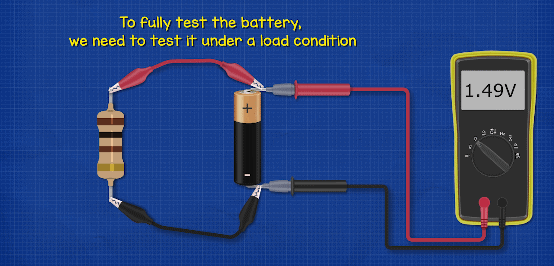
So we take a resistor of around 100 Ohms, it doesn’t have to be exactly this value though, but we connect the resistor between our two probes. In this case we’ve just used some crocodile clips to connect the resistor between the probes, like this.
This way current will flow through the resistor and we can take a voltage reading as this occurs. If the battery is still good, then the voltage level will only drop slightly.

For example this battery has a rated voltage of 1.5V, with no load it is 1.593V, with the resistor connected it is 1.547V so this is still good.

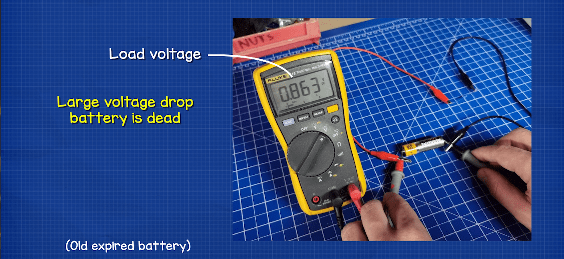
This battery is also rated at 1.5V, when we measure it with no load it has a reading of exactly 1.5V, but when we connect the resistor it drops to 0.863V so we know this has run out of charge.
But now that you’re all charged up, checkout squarespace to create your own online web presence which is packed with features to empower individuals to launch, share and promote their own projects.
There’s powerful blogging tools to showcase your projects photos, videos and progress updates.
You can easily schedule appointments for classes and sessions with team members and clients through their built in tool. And you can even collect payments or donations to help support your cause.
Leave a Reply