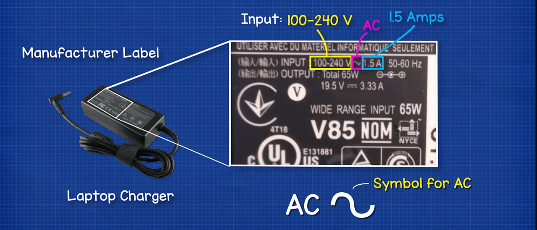
If you look on the plugs of your electrical devices, you should find labels from the manufacturers which tell you what the product is designed to handle. For example, this laptop charger tells us that for the device to work, it needs an input of between 100 and 240 volts and 1.5 amps of AC or alternating current, which is represented by this symbol here.
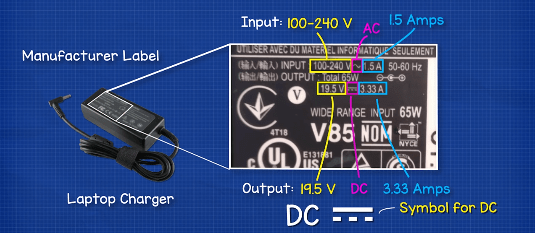
The Charger will then convert this to give an output of around 19.5 volts and 3.33 amps of DC or direct current, which is represented by this symbol.
AC and DC are different types of electricity, the plugs in your homes provide AC or alternating current. In this type the electrons do not flow in a continuous loop. Instead, they alternate between moving forwards and backwards, just like the tide of the sea. Your electrical devices, like laptops and mobile phones, will use DC electricity.
In this type the electrons flow in one direction only – directly from one terminal to the other. You can think of this like the flow of water down a river. In most cases, we transport electricity from a power station to the towns and cities using AC electricity because it’s easy to increase and decrease the voltage using transformers. And it’s also very efficient to transport electricity over long distances using this method. However, there are a few high voltage DC transmission lines being used, but we won’t go too much into detail on those.

We mostly use DC direct current for the circuit boards of small electronic devices like laptops, mobile phones and TVs. That’s because D.C. is easier to control and allow circuits to be smaller and more compact, many appliances will use a combination of AC and DC. For example, a washing machine will use AC for the induction motor, which is used to spin the tub with the clothes in. But the circuit board, which controls the settings, the lights, the timers, as well as how fast the motor spins, will use DC power.
We can convert AC to DC using a device known as a rectifier. This is extremely common in electronics. We can also convert DC to AC using an inverter and this is used, for example, with solar power systems. We have covered power inverters in great detail previously.
People often refer to a river or the tide of the sea as having a strong current. It’s very similar to electricity.
A river with a lot of fast flowing water is said to have a strong current, the same of electricity. A cable with a lot of electrons flowing also has a high current. A river is able to handle a certain amount of water flowing through it. But if more water enters than it can handle than the river will burst its banks. The same with electricity, the cable will burst and burn out. Therefore, manufacturers need to be able to test cables and lamps to find out how much current they can handle.
We also want to be able to see how much current is flowing through our circuits, as well as being able to calculate this, we can measure this using an ammeter, and we measure the flow of current in the unit of amperes. But you usually hear people just shorten this to amps. So what is an amp? One amp is equal to one coulomb per second and one coulomb is equal to approximately six quintillion, 242 quadrillion electrons per second. OK, but what does that mean?
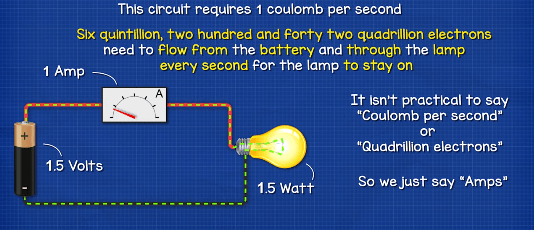
Another way to look at this is that to power this 1.5 watt lamp with a 1.5 volt battery requires a current of one amp. That means that the circuit requires one coulomb per second, which means approximately six quintillion, 242 quadrillion electrons need to flow from the battery and through the lamp every second for the lamp to stay on. But as you can see, it’s not very practical to say how many electrons per second are flowing. So engineers just say amps to save time. The brightness of the lamp will vary with voltage.
As we decrease the voltage, there is less pressure pushing the electrons so less electrons flow. As we increase the voltage, more electrons flow and the lamp shines brighter. But don’t forget, at a certain voltage and current, a lamp will burn out. To measure the current in a circuit, we need to connect an ammeter in series so that the current flows through it. Think of it like a water meter. The water in a pipe needs to flow through the water meter for us to know how much water is flowing.
Likewise, we need the electrons to flow through our ammeter, instead of using an ammeter, we’re going to use a multimeter as we can do a lot more with this device. I highly encourage you to get one of these for your tool kit. They’re an essential tool for any electrical engineer.
If we connect this 1.5 volt battery and this lamp, which has a resistance of one ohm, then we get a current reading of 1.5 amps.

Which means nine quintillion 636 quadrillion electrons are flowing through the line every second. Because the components of this circuit are wired in series, the current is the same anywhere in the circuit, so we can take a measurement anywhere and it’s the same value. If we add another lamp to the circuit connected again in series and the lamp also has a resistance of one ohm, then we’re adding more resistance to the circuit. So it’s now harder for the electrons to flow through. And so we see a reduction in current. In this case, we get a reading of 0.75 amps, which means four quintillion 818 quadrillion electrons are flowing.
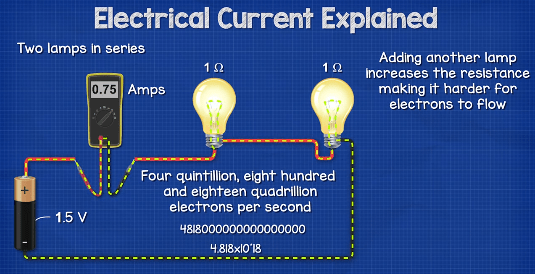
This circuit is in series. So again, we can move the multimeter and we get the same reading. If we now connect the circuit with two lamps in parallel, both with a resistance of one ohm and connect this circuit to a battery of 1.5 volts, then in the main wire from and to the battery, we get three amps.
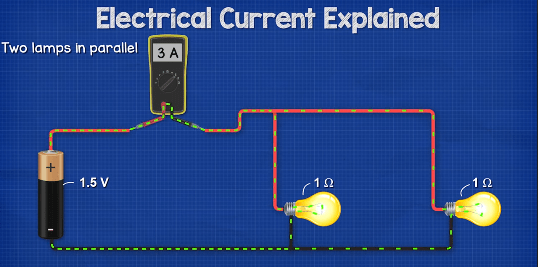
But on the branch of each lamp, we get 1.5 amps because the path of the electron splits. So they are shared between the two lamps. The path then merges again- So we get the combined total circuit current of 3 amps because both lamps have the same resistance, they have the same current. But for example, if A has a resistance of one Ohm and that B has a resistance of three ohms, then in the main wire we get an amp reading of two amps. In the branch for Lamp A, we get 1.5amps and in the branch for Lamp B, we get 0.5amps.

Notice though, that lamp B is dimmer. That’s because the resistance is higher, which makes it difficult for electrons to flow through. In both cases, the amps and the branches all add up and are equal to the total current flowing in the main wire to and from the battery. Therefore, we can add resistors to our circuits to restrict how much current can flow.
Leave a Reply