
What is a PLC
PLC stands for programmable logic controller. There are many variations but they typically look something like this.
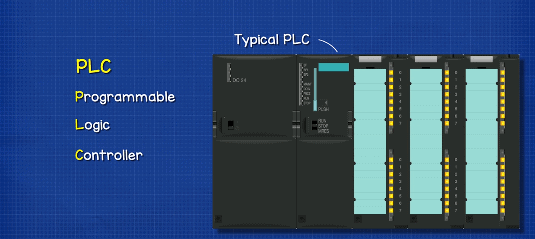
A Programmable Logic Controller is basically a small computer that can carry out pre-programmed outputs based on inputs and a set of specific rules.
They are used in commercial and industrial applications to control systems with minimal and sometimes even zero manual intervention. The operation can be a simple on off control based on the status of the input or a more sophisticated response based on calculations, sequence and logic.
Why Do We Need PLC’s?
Before PLCs, control was carried out via banks of relays. Each relay controlled dedicated inputs and outputs based on physical wiring. Relays would control other relays to form logic controllers. For example with a simple AND gate, only when 2 inputs are energised, this one AND this one, does the relay output energise. These inputs could be sensors or they could be outputs from other relays.

To change the operation, the physical wiring had to be changed, so the physical connections had to be altered if a different response was required.
These old banks of relays were vast in size and very complex. This is an example of an elevator relay bank. And this is the relay bank from an old electrical substation.

As you can imagine, these are not going to be easy to change and finding faults can be difficult and very time consuming.
With the invention of solid-state electronics and microchips, the command logic part of the banks of relays could be replaced with software logic and so PLC’s quickly took over.
PLCs vary widely on their application but they all monitor their inputs, then make a decision based on a stored set of rules and from those, they then output commands to automate a process.
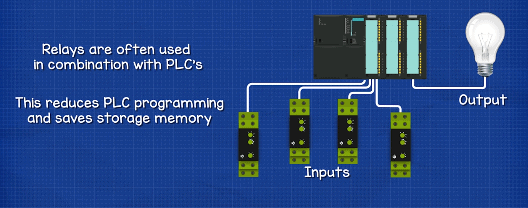
We often find relays used in combination with PLC’s. The relays can directly deal with the automation task and communicate with the PLC. This will reduce the amount of programming required on the PLC and also free’s up storage space.
PLC’s are widely used, for example, when you check your bag in at an airport. The bag is given a bar code and enters the conveyor belt. A PLC scans the barcode and, based on a set of rules, decides if the bag is diverted to either the domestic or international route. The next PLC scans the barcode and decides which city the bag needs to be diverted to. The next PLC decides which gate it also needs to be diverted to. And If it all of this goes to plan, then the bag will arrive at the correct gate.
Leave a Reply