There are two restrictive challenges of employing symmetric key cryptography.
- Key establishment − Before any communication, both the sender and the receiver need to agree on a secret symmetric key. It requires a secure key establishment mechanism in place.
- Trust Issue − Since the sender and the receiver use the same symmetric key, there is an implicit requirement that the sender and the receiver ‘trust’ each other. For example, it may happen that the receiver has lost the key to an attacker and the sender is not informed.
These two challenges are highly restraining for modern day communication. Today, people need to exchange information with non-familiar and non-trusted parties. For example, a communication between online seller and customer. These limitations of symmetric key encryption gave rise to asymmetric key encryption schemes.
Asymmetric Key Encryption
The encryption process where different keys are used for encrypting and decrypting the information is known as Asymmetric Key Encryption. Though the keys are different, they are mathematically related and hence, retrieving the plaintext by decrypting ciphertext is feasible. The process is depicted in the following illustration −
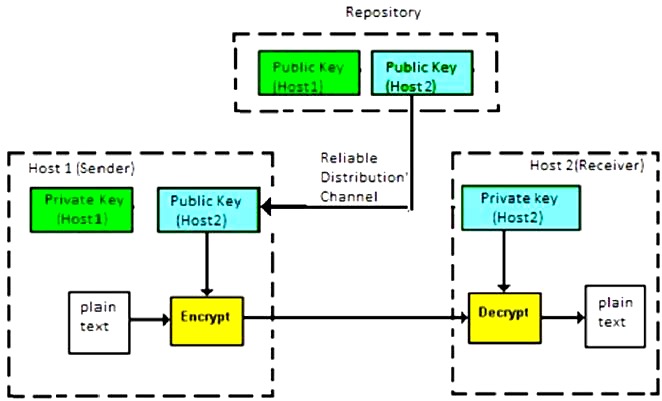
Asymmetric Key Encryption was invented in the 20th century to come over the necessity of pre-shared secret key between communicating persons. The salient features of this encryption scheme are as follows −
- Every user in this system needs to have a pair of dissimilar keys, private key and public key. These keys are mathematically related − when one key is used for encryption, the other can decrypt the ciphertext back to the original plaintext.
- It requires to put the public key in public repository and the private key as a well-guarded secret. Hence, this scheme of encryption is also called Public Key Encryption.
- Though public and private keys of the user are related, it is computationally not feasible to find one from another. This is a strength of this scheme.
- When Host1 needs to send data to Host2, he obtains the public key of Host2 from repository, encrypts the data, and transmits.
- Host2 uses his private key to extract the plaintext.
- Length of Keys (number of bits) in this encryption is large and hence, the process of encryption-decryption is slower than symmetric key encryption.
- Processing power of computer system required to run asymmetric algorithm is higher.
Symmetric cryptosystems are a natural concept. In contrast, public-key cryptosystems are quite difficult to comprehend.
You may think, how can the encryption key and the decryption key are ‘related’, and yet it is impossible to determine the decryption key from the encryption key? The answer lies in the mathematical concepts. It is possible to design a cryptosystem whose keys have this property. The concept of public-key cryptography is relatively new. There are fewer public-key algorithms known than symmetric algorithms.
Leave a Reply