Something that’s going to cause you great confusion when you’re learning about electricity is the difference between conventional current and electron flow. These are both theories of how electricity works. When Benjamin Franklin was first experimenting with electricity, he had the idea that something must be flowing inside the materials, he was given a glass tube. And when this was rubbed with a cloth, it seemed to accumulate this strange, invisible fluid because when someone else touched the tube, they received a small shock.
We now know this as static electricity. But at the time, Benjamin Franklin assumed that the tube was accumulating an excess amount of this invisible fluid. So he considered this to be positive and the person touching it must have less of this fluid, so they were considered negative. So he said, ‘OK, I guess this end is positive and this end is negative and electricity flows from positive to negative’. And this does make sense because water is a fluid and it flows from a high level to a low level.

Soon, manufacturers started producing batteries based on his work, and so they also said, well, this end is positive and this end is negative and we still use this naming convention to this day. This became known as conventional current because it’s the conventional theory of how electricity flows. However, as science evolved and experiments became more precise, someone called Joseph Thompson discovered that this invisible thing moving inside the wire was a particle, and he named this particle an electron.
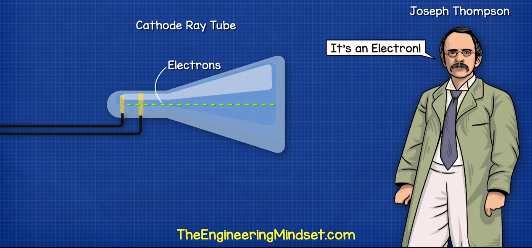
He also discovered these electrons were actually flowing in the opposite direction from the negative to the positive. Benjamin Franklin didn’t realize the silk cloth was actually removing electrons from the glass, so they were actually flowing from the person and to the glass tube. Joseph Thompson’s theory became known as electron flow because it’s the flow of electrons and so what’s actually occurring, is these electrons are flowing in a circuit from the negative to the positive terminal and not the positive to the negative.
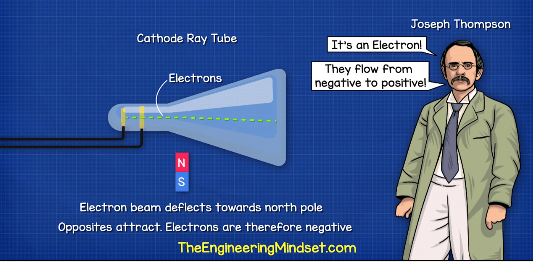
However, it doesn’t really matter what’s moving inside the wire or in which direction, because the electrical engineering formulas we use do not take this into account. So they will still come out with the same answers. It’s also a little bit too late now to change the names of the terminals of all the batteries in the world. So everyone just kind of ignored this and we continue to teach and use conventional current. Some books might show you both.
So you need to remember that whenever we talk about electricity or whenever we design a circuit or even look at an electrical circuit drawing, we always default and assume conventional current is occurring. But engineers and scientists know that the electrons are actually flowing the other way.
Leave a Reply