Hopefully you are a bit clearer about the logic and terminology of Bitcoin transactions, but to really get to grips with them let’s look at the anatomy of a bitcoin transaction. We’re using a random example from 2016:
- Time/Date – This transaction occurred at 17:41 17th June 2016
- Status – Whether the transaction is Confirmed (Green) or Unconfirmed (Red). Confirmed status means that the transaction has been included in at least six blocks.
- Transaction Hash – All the data within the transaction is hashed cryptographically so it can be referenced within a block in a uniform alphanumeric string.
- Received time – The time and date the funds were received.
- Size – The amount of data the transaction represents, measured in bytes. A bitcoin block has a maximum size of 1mb.
- Weight – This is a unit of measurement used to compare the sizes of different transactions. Weight measurements are relative to the maximum size of a block. As of 2016, each weight unit represents 1 / 4,000,000 of a block. So in this particular transaction, it’s taking up 900 of the 4,000,000 capacity of the block it has been added to.
- Included in block – the block number in the chain that the transaction has been added to.
- Confirmations – the number of blocks the transaction has been added and therefore considered as valid. Since this transaction happened in 2010, and a new block is confirmed every 10 minutes, there are a lot of confirmations.
- Total input – the total funds sent including fees.
- Total output – the total funds received .
- Fees – the amount of fees that were paid to the miner to include this transaction in a new block and add that to the Bitcoin blockchain.
- Fee per Byte – The fee relative to the size of the transaction
- Fee per weight unit – The fee relative to the weight of the transaction
- Value when transacted – value (at the time of the transaction) of the transacted BTC represented in USD.
Below the summary information you can see the source of funds addresses that provided the Input (as described above). and the destination addresses – the Outputs
Bitcoin is just a record of unspent funds, so when funds are moved, an unspent transaction becomes an Input in a new transaction and ultimately an Output somewhere else in the blockchain.
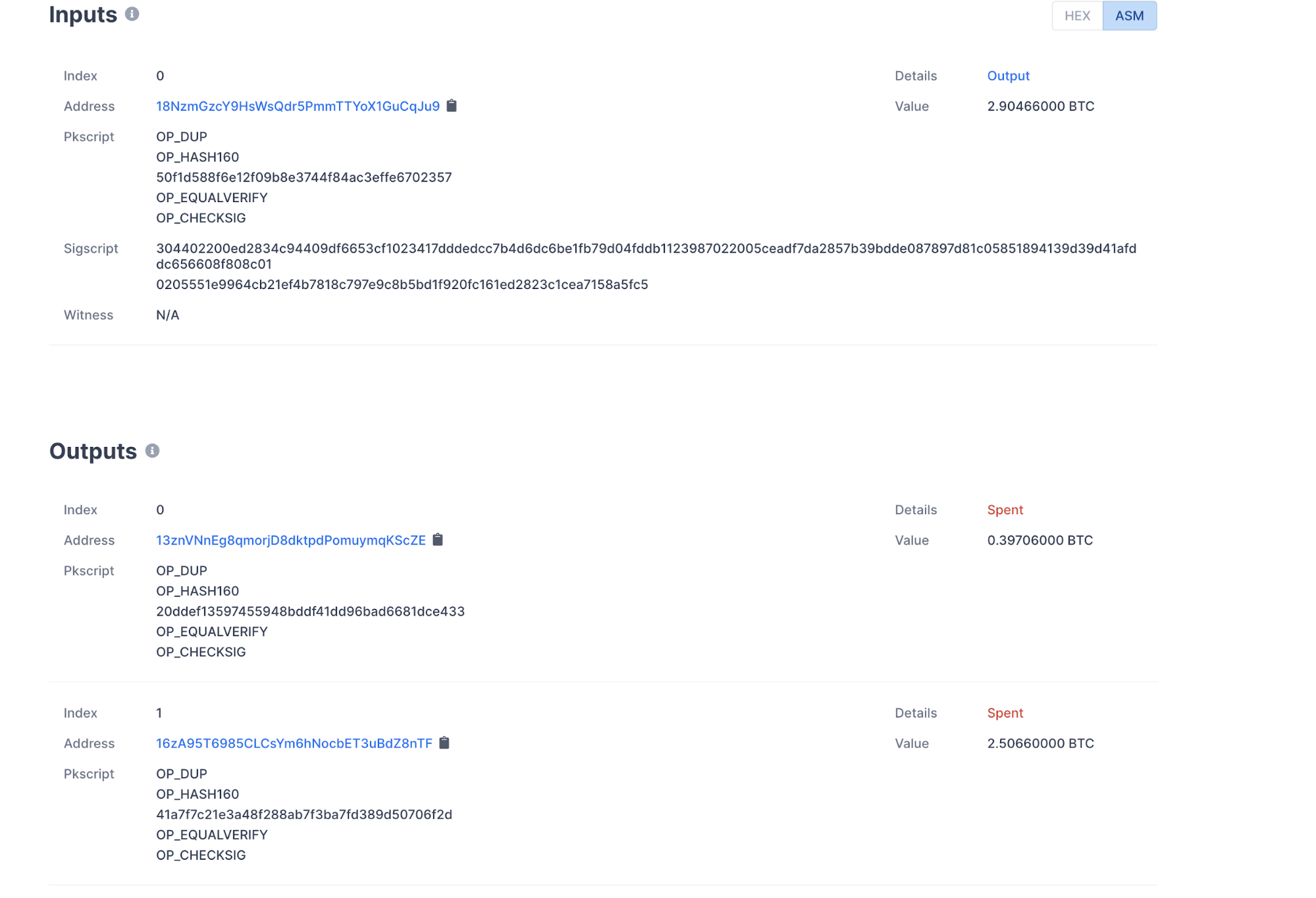
Inputs
The input into a transaction has to cover the value of the BTC being sent and the relevant fees needed to confirm the transaction as valid. The details in this section include the sender’s address and the amounts of BTC sent and fees paid.
Outputs
This section details the addresses of those receiving the transacted BTC. It also includes the value of the BTC they have received (which amounts to the input minus the fees).
You’ll notice across from ‘details’ the ‘spent’ written in red. This indicates that this particular BTC has been spent in a subsequent transaction, illustrating the point about forward movement of funds.
Ethereum’s blockchain works in a very similar way, though with a slightly different fee system known as Gas. Gas fees are similar to Bitcoin transaction fees in that they are paid to Miners, but the calculation is based on the complexity of the transaction.
This is more complicated with Ethereum because a transaction could simply be the movement of ETH (the native currency) or to facilitate the execution of a Smart Contract, which takes more computing power.
Ethereum fees are measured in Gas but paid for in Ether. The conversion to Gas is to provide a more user friendly unit, but is quite confusing. Gas itself is denominated in Gwei, one Gwei being equal to 0.000000001 ETH (10-9 ETH) so instead of a Gas Fee being 0.000000001 Ether it would be written as 1 Gwei.
Leave a Reply