Transformers are used in various fields like power generation grid, distribution sector, transmission and electric energy consumption. There are various types of transformers which are classified based on the following factors;
- Working voltage range.
- The medium used in the core.
- Winding arrangement.
- Installation location.
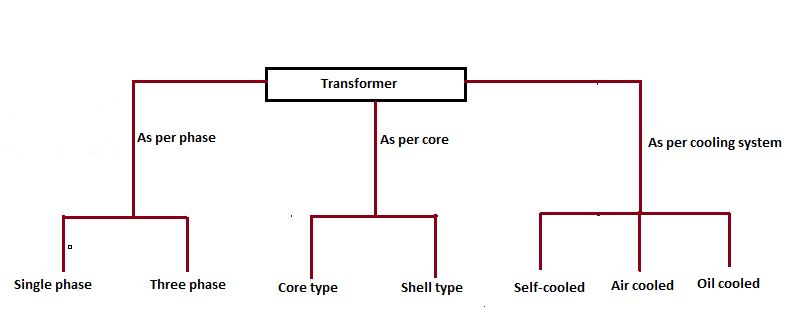
Based on Voltage Levels
Commonly used transformer type, depending upon voltage they are classified as:
- Step-up Transformer: They are used between the power generator and the power grid. The secondary output voltage is higher than the input voltage.
- Step down Transformer: These transformers are used to convert high voltage primary supply to low voltage secondary output.
Based on the Medium of Core Used
In a transformer, we will find different types of cores that are used.
- Air core Transformer: The flux linkage between primary and secondary winding is through the air. The coil or windings wound on the non-magnetic strip.
- Iron core Transformer: Windings are wound on multiple iron plates stacked together, which provides a perfect linkage path to generate flux.
Based on the Winding Arrangement
- Autotransformer: It will have only one winding wound over a laminated core. The primary and secondary share the same coil. Auto also means “self” in language Greek.
Based on Install Location
- Power Transformer: It is used at power generation stations as they are suitable for high voltage application
- Distribution Transformer: Mostly used at distribution lanes for domestic purposes. They are designed for carrying low voltages. It is very easy to install and characterized by low magnetic losses.
- Measurement Transformers: These are further classified. They are mainly used for measuring voltage, current, power.
- Protection Transformers: They are used for component protection purposes. In circuits, some components must be protected from voltage fluctuation etc. Protection transformers ensure component protection.
Leave a Reply